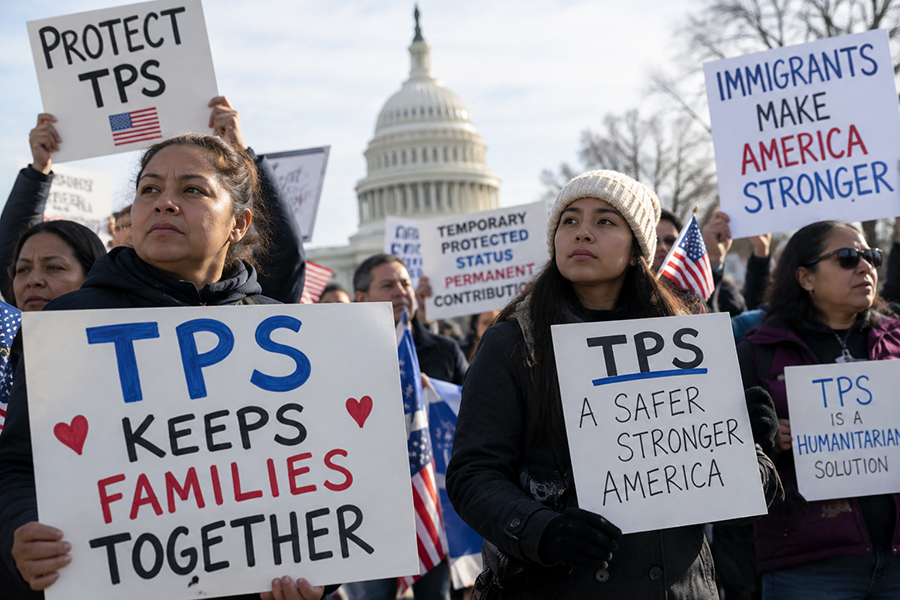
This title doesn't match the record. Neither El Salvador nor Ukraine lost temporary protected status (TPS) in September 2026. Instead, both countries automatically extended their designations by federal statute when the U.S. Department of Homeland Security missed its legal deadline to decide whether to terminate them.
El Salvador's review deadline was July 10, 2026; when DHS did not publish a termination decision by then, the law triggered a 6-month automatic extension. Ukraine followed the same pattern, with a missed August 20, 2026 deadline automatically extending its designation to April 19, 2027. The two countries' cases illustrate how a federal law designed to protect TPS holders works when a government agency does not act. Neither the September 9 expiration date for El Salvador nor the October 19 date for Ukraine took effect as terminations. Instead, approximately 170,000 Salvadorans and roughly 1,000 Ukrainian nationals retained their TPS and work authorization pending future formal decisions from DHS.
Table of Contents
- What Triggered the Automatic Extensions?
- El Salvador's Missed Deadline and What Actually Happened
- Ukraine Followed the Same Pattern Two Months Later
- What Changed After the Supreme Court Ruling?
- What Happens Next?
- Frequently Asked Questions
What Triggered the Automatic Extensions?
tps designations are temporary by design and require periodic review. When a designation approaches expiration, federal law gives the Department of Homeland Security 60 days before the end date to decide publicly in the Federal Register whether to extend or terminate the status.
For El Salvador, the statutory deadline was July 10, 2026—60 days before the september 9 expiration. For Ukraine, the deadline was August 20, 2026. DHS did not publish formal decisions by either deadline. When an agency misses this statutory window, federal law does not punish TPS holders—it punishes inaction with an automatic extension.
The law says that if DHS has not terminated the status by the published deadline, the status continues for another six months. This mechanism exists so that people do not lose protection while the government delays.
El Salvador's Missed Deadline and What Actually Happened
El Salvador's TPS designation covered approximately 170,000 people. The September 9, 2026 date came and went without a formal DHS termination notice. On that same day, DHS released a statement saying only that "an announcement on El Salvador's TPS will be made at the appropriate time," and explicitly noted that Salvadorans retained protection until a decision was issued.
Because DHS missed the July 10 deadline to decide, the automatic extension took effect. Salvadorans with TPS kept their status and continued to hold work authorization. The designation remained active pending a future formal decision—it was not terminated.
Ukraine Followed the Same Pattern Two Months Later
Ukraine's case is similar but the dates differ. Ukraine's TPS termination was scheduled for October 19, 2026—not September—and DHS's statutory deadline to decide was August 20, 2026. Like El Salvador, DHS did not publish a decision in the Federal Register by that deadline, triggering an automatic 6-month extension that continues the designation through April 19, 2027.
The Ukrainian TPS population is much smaller, with roughly 1,000 nationals holding the status. They also retained work authorization when the extension took effect. The automatic extension again protected TPS holders from losing status while DHS delayed its decision.
What Changed After the Supreme Court Ruling?
The timing of these automatic extensions matters because of a Supreme Court decision earlier in 2026. On June 25, 2026, the Supreme Court ruled in Mullin v. Doe that legal barriers to TPS terminations no longer applied, clearing the way for the government to terminate designations more readily. However, neither El Salvador nor Ukraine was terminated after that ruling.
Instead, both missed their respective decision deadlines, and the automatic statutory extension protected both groups. DHS later announced it would consider future decisions on both countries' designations, but as of September 2026, the law had already acted to extend protection when the agency did not.
What Happens Next?
Both extensions are temporary. El Salvador's designation will again require a DHS decision before the new March 9, 2027 deadline. Ukraine's will require one before April 19, 2027. TPS holders should not assume ongoing status without monitoring official announcements from USCIS, but they should also know that a missed government deadline does not automatically end their protection—the law extends it instead.
Frequently Asked Questions
Did El Salvador and Ukraine lose TPS status in September 2026?
No. While September 9, 2026 was El Salvador's original expiration date, DHS's failure to decide by the July 10 deadline triggered an automatic 6-month extension. Ukraine's deadline was October 19, and the same statutory extension applied. Both countries retained TPS status.
What happens if DHS still does not decide by the next deadline?
The same rule applies. If DHS does not publish a formal decision in the Federal Register by the deadline (March 9, 2027 for El Salvador, April 19, 2027 for Ukraine), the status will automatically extend for another 6 months. TPS holders should monitor official USCIS announcements, but they do not need to assume the worst if a deadline passes without action.
Does this automatic extension mean TPS is permanent?
No. The extension is temporary and buys time for DHS to make a decision. Eventually, DHS must either formally extend or formally terminate the designation. The automatic extension is a procedural protection, not a final answer.