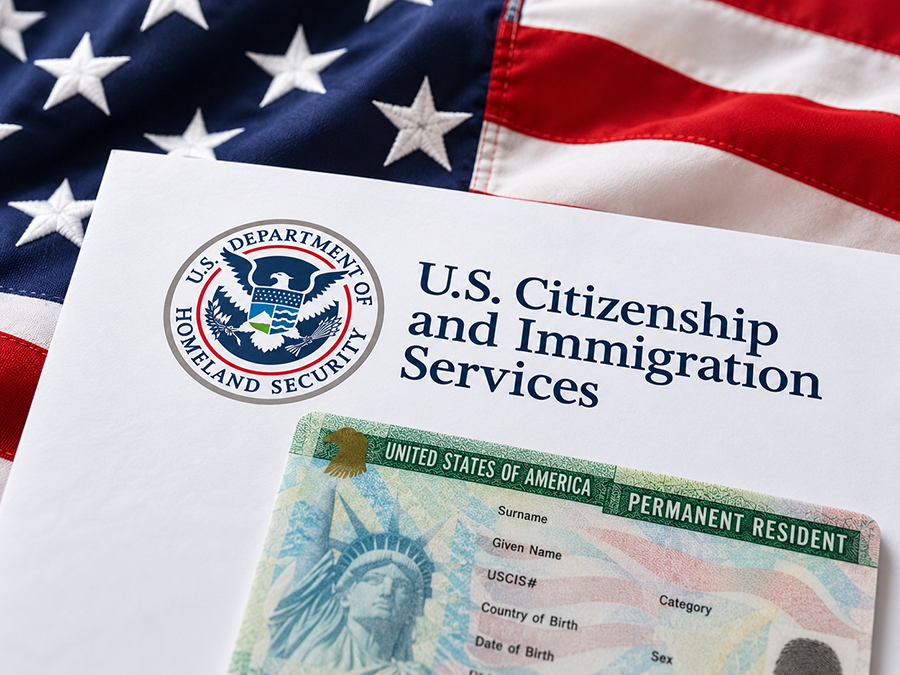
To sponsor a spouse for a U.S. green card, you must be a U.S. citizen or green card holder who files Form I-130 (Petition for Alien Relative) with USCIS. The sponsorship process typically takes 12.9 months for immediate relatives, though the timeline varies based on where your spouse applies.
Sponsoring a spouse is one of the fastest family-based immigration routes. If you are a U.S. citizen, your spouse faces no visa number wait, even if applying from abroad. If your spouse is already in the United States through lawful admission, you may file both the I-130 and the adjustment application concurrently, potentially speeding the path to permanent residency.
Table of Contents
- Only U.S. Citizens and Green Card Holders Can Sponsor
- Filing from Inside or Outside the U.S.
- Required Forms, Fees, and Documentation
- Your Sponsor Obligation Under Form I-864
- Processing Timeline and Next Steps
- Frequently Asked Questions
Only U.S. Citizens and Green Card Holders Can Sponsor
Only U.S. citizens and permanent residents may petition for a spouse. your spouse must intend to live in the United States as a permanent resident, and the marriage must be legally valid in the jurisdiction where it took place. U.S. citizen sponsors benefit from immediate relative status, which carries unlimited visa availability and no visa number wait. If you are a green card holder, you may also sponsor your spouse, and the filing process starts with Form I-130.
Filing from Inside or Outside the U.S.
Where your spouse is located when you file determines your filing strategy. If you are a U.S. citizen and your spouse is already in the United states with a valid admission (for example, on an F-1 student visa or B-1/B-2 tourist visa), you and your spouse can file Form I-130 and Form I-485 (Application to Register Permanent Residence or Adjust Status) at the same time.
This concurrent filing is available because immediate relatives have no visa number wait. If your spouse is outside the United States, or if you are a green card holder, you file Form I-130 first. Once uscis approves the petition, your spouse's case moves to the State Department's National Visa Center for consular processing. Your spouse schedules a visa interview at a U.S. embassy or consulate, completes medical examination and background checks, and receives an immigrant visa to enter the U.S. as a lawful permanent resident.
Required Forms, Fees, and Documentation
The filing fee for Form I-130 is $625 online or $675 by mail. You must submit a certified marriage certificate from the civil authority where the marriage took place, plus evidence that the marriage is genuine, such as joint bank accounts, joint property ownership, or affidavits from people who know you as a couple. You must also complete Form I-864 (Affidavit of Support), which proves you can financially support your spouse at 125% of the federal poverty line for your household size.
If you are on active military duty, you only need 100%. You may use assets (valued at three times the income shortfall) or have a household member add their income by signing Form I-864A to meet the requirement. If your spouse is adjusting status in the United States, a medical examination by a USCIS-designated civil surgeon must be submitted. If your spouse applies from abroad, this exam happens at the consulate as part of visa processing.
Your Sponsor Obligation Under Form I-864
When you sign Form I-864, you are making a legally binding commitment. You agree to financially support your spouse if they cannot support themselves. This obligation typically lasts until your spouse becomes a U.S. citizen or completes 40 qualifying work quarters (roughly 10 years of employment). In some cases, the obligation may continue longer. The Form I-864 is a serious legal commitment.
Do not sign unless you genuinely intend to support your spouse for the full duration of the obligation. If your household income falls short of the requirement, a joint sponsor may co-sign or you may use savings and assets to meet the 125% threshold.
Processing Timeline and Next Steps
After you submit Form I-130, USCIS will send you a receipt notice within days. The median processing time for immediate relative petitions is 12.9 months, though this varies by USCIS service center. You can check your case status at any time using your receipt number on the USCIS online system. If your spouse is applying from abroad, the National Visa Center will contact your spouse once the I-130 is approved with a case number and request for supporting documents.
Your spouse then schedules a visa interview at a U.S. embassy or consulate. If your spouse is adjusting status inside the U.S., USCIS will issue a receipt notice for the I-485 and schedule a biometrics appointment and interview.
Frequently Asked Questions
Can I sponsor my spouse if I am a green card holder?
Yes. Green card holders can petition for spouses through family-based immigration. However, the process differs from citizen sponsorship in terms of visa availability and processing timelines.
How long does the entire process take?
The I-130 petition typically takes a median of 12.9 months. If your spouse is applying from outside the U.S., add several months for National Visa Center processing and the consular visa interview. If adjusting status inside the U.S., the I-485 may be decided within 4–12 months.
What if my income is too low to meet the 125% poverty line requirement?
You can add a joint sponsor who signs Form I-864A and accepts co-liability, or you can document sufficient assets (valued at three times the income shortfall) to meet the threshold.
Is the Form I-864 affidavit temporary?
No. The obligation is legally binding and typically lasts until your spouse becomes a U.S. citizen or completes 40 qualifying work quarters, roughly 10 years of employment. It may extend longer in some circumstances.