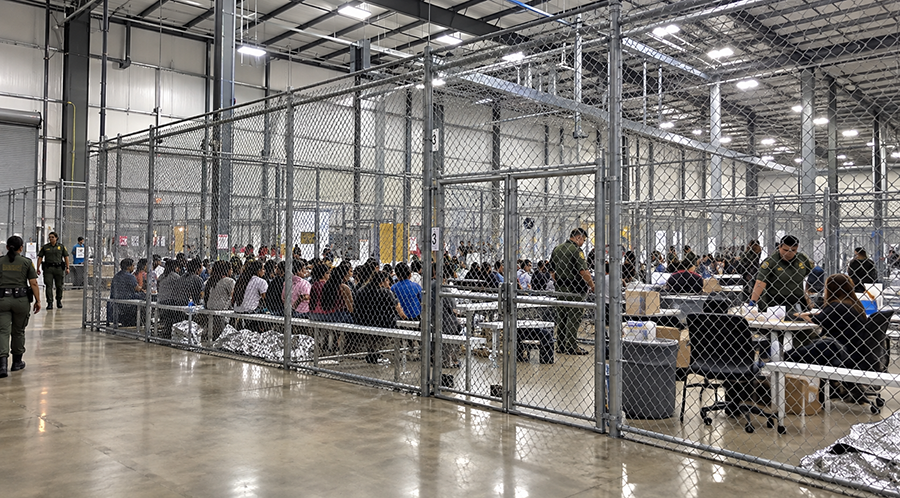
The Supreme Court agreed on Thursday to decide whether the Trump administration can lock up immigrants arrested inside the country for the entire length of their deportation cases without ever letting a judge consider releasing them on bond. The case, one of the first the justices took after returning from summer recess, could affect millions of people, according to the ACLU.
The immigrant at the center of it is Ricardo Aparecido Barbosa da Cunha, a Brazilian who entered the United States about twenty years ago, applied for asylum in 2016 and has never been charged with a crime. ICE arrested him in September 2025. An immigration judge ruled that under the administration’s new reading of the law his detention was mandatory, so the judge could not even hold a hearing on whether he should be released. He sued, won in the lower courts, and the government asked the Supreme Court to reverse. Arguments are expected in the coming months, with a decision likely by the end of June 2027.
How a Border Statute Became a Nationwide Detention Rule
For roughly 30 years, immigration law has had two detention tracks. People stopped at the border or a port of entry are treated as applicants for admission under Section 235 of the Immigration and Nationality Act and must be detained. People arrested inside the country are held under Section 236, which lets an immigration judge decide whether to release them on bond. Prior administrations, including Trump’s first, generally applied the second track to people who had crossed the border years earlier and were picked up at home, at work or in traffic.
In 2025 ICE began arguing that anyone who originally entered without inspection is still an applicant for admission no matter how long they have lived here, and therefore falls under the mandatory track. In September 2025 the Board of Immigration Appeals adopted that reading in Matter of Yajure Hurtado, a precedent binding on every immigration judge. From that point, a person who crossed the border in 2005, raised a family and was arrested in 2025 could not ask for bond at all. The only route out was a habeas petition in federal court.
Tens of thousands of people took that route. According to The Marshall Project, more than 500 federal judges rejected the government’s interpretation in roughly 20,000 cases over the past year, and in February a federal judge issued a class-wide order in Maldonado Bautista forcing the government to resume bond hearings after finding it had ignored an earlier order. Nine of the eleven appeals courts to rule have sided with the immigrants. The Fifth and Eighth Circuits sided with the government, which is the split the Supreme Court is stepping in to resolve.
The Arguments
The government’s case, filed by Solicitor General John Sauer, rests on the text of the 1996 law. It says a person who entered without admission has never been admitted and is therefore still seeking admission, whatever the calendar says. Detention, Sauer wrote, prevents people from evading hearings and helps ensure their removal. The administration also leans on practicality: the patchwork of circuit rulings means an immigrant arrested in Texas sits in detention while an identical person arrested in a state whose courts rejected the policy gets a bond hearing and is often released, and federal courts are drowning in habeas petitions.
The ACLU, representing Barbosa da Cunha, argues that the government’s reading swallows the bond provision for the largest group of immigrants it was written for, which Congress cannot have intended. The 2018 decision in Jennings v. Rodriguez, which the government cites, held that the mandatory provision does not require periodic bond hearings for people it covers; it did not decide who it covers. The ACLU also raises the constitutional problem lurking behind the statute: imprisoning someone for months or years with no individual assessment of flight risk or danger is the kind of thing due process is supposed to forbid.
The Court chose this case over a different one the administration preferred, which would have squarely raised those constitutional questions. Taking the narrower statutory case suggests the justices want to decide what the law says before deciding whether the law is allowed. A ruling for the government would make no-bond detention the rule nationwide for anyone who entered without inspection. A ruling for Barbosa da Cunha would restore the bond hearing, though not a right to release; judges could still deny bond case by case.
What This Means for Detained Immigrants Right Now
Nothing changes today. Granting review does not pause the policy, and it does not pause the lower-court rulings against it. If you are detained in a circuit that has rejected the government’s reading, you can still file a habeas petition and expect a bond hearing. If you are detained in Texas, Louisiana, Mississippi or the seven Eighth Circuit states, that route is closed for now.
What changes is the clock. ICE knows the question will be settled within nine months, and it has little reason to change course before then. Expect the agency to keep classifying interior arrests as mandatory everywhere and to fight habeas petitions one at a time. Immigration lawyers have long reported detainees being transferred to Fifth Circuit facilities, where the policy is upheld, and nothing about Thursday’s order discourages that.
For families with someone in detention, the practical steps are the same as before the grant, but with more urgency:
- File the habeas petition now if you are in a favorable circuit. A bond hearing won before the Supreme Court rules is a bond hearing you had; the government cannot easily undo a release that has already happened.
- Document where the person was arrested and where they are held. Venue decides which circuit’s law applies, and transfers after arrest are a known tactic.
- Keep the underlying case moving. The Supreme Court is only deciding detention. The deportation case runs on its own track, and relief granted there ends the detention regardless of the bond question.
- If the person entered through a port of entry, overstayed a visa or was paroled in, say so loudly and early. The policy applies only to people who entered without inspection, so make sure ICE has classified you correctly.
For anyone who entered without inspection and is not yet detained, the question between now and then is whether there is any status they can pursue while they can still walk into a lawyer’s office rather than call one from a detention center.