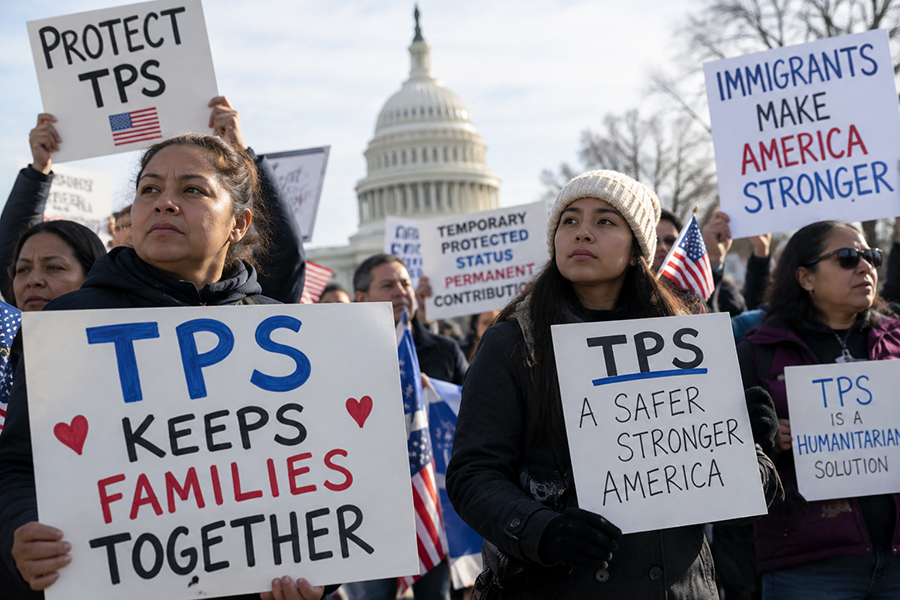
Temporary Protected Status is almost gone. When President Trump took office in January 2025, 17 countries had TPS designations covering about 1.3 million people. As of this week, 13 of those designations have been terminated, according to the Congressional Research Service, and the four that remain, El Salvador, Ukraine, Sudan and Lebanon, all face decisions this fall. Ukraine and Sudan expire on October 19, two weeks from today.
The reason the terminations stuck is a Supreme Court ruling from June. In Mullin v. Doe, the justices held 6-3 that federal courts cannot review the Homeland Security secretary’s decision to end a country’s TPS, no matter how the decision was reached. Lower courts had blocked seven of the terminations, some for close to a year. Within two months of the ruling, every one of those blocks was lifted, and deportation flights to Haiti, Honduras, Nepal and other former TPS countries began. This guide explains what the Court decided and where each of the 17 countries stands now.
What the Supreme Court Decided
Mullin v. Doe began as two cases, one by five Haitian TPS holders and one by Syrian TPS holders. District judges in both found that then-Secretary Kristi Noem had skipped steps the TPS statute requires, such as actually reviewing conditions in the country, and blocked the terminations. The administration appealed to the Supreme Court, which took the unusual step of hearing the case on an expedited schedule in April.
On June 25, Justice Samuel Alito wrote for the majority that the TPS statute’s text is clear: there is no judicial review of any determination of the secretary with respect to the designation, termination or extension of a country’s TPS. That bar, the Court held, covers not just the final decision but the process behind it, so a challenge claiming the secretary did not do the required review is also out of bounds. The Court also rejected the Haitian plaintiffs’ claim that the termination was driven by racial animus, finding it unlikely to succeed. When the challengers warned that this would let a secretary end TPS on a coin flip, Alito answered that Congress could stop such abuse through the appropriations process.
Justice Elena Kagan, joined by Justices Sotomayor and Jackson, dissented. In her reading, the statute bars review of the secretary’s determinations, not of whether the secretary followed the law in reaching them, and she wrote that the majority had left courts powerless to enforce the procedures Congress wrote into the program. Justice Thomas, in a concurrence, would have gone further and barred the constitutional claim too.
The practical result is that the only way left to challenge a TPS termination is a constitutional claim, and the Court’s handling of the Haitian claim suggests those face long odds. DHS general counsel James Percival summed up the administration’s view the same day: the T in TPS stands for temporary.
Where Every Country Stands
Beneficiary counts are the most recent government figures compiled by the Congressional Research Service and the National TPS Alliance; they are rounded and predate the terminations.
| Country | Status as of October 5, 2026 | TPS ended or expires | People covered |
|---|---|---|---|
| Afghanistan | Terminated | July 14, 2025 | 11,700 |
| Cameroon | Terminated | August 4, 2025 | 5,500 |
| Venezuela | Terminated, both designations | 2021 designation ended November 7, 2025; last work permits expired October 2, 2026 | 600,000 |
| Honduras | Terminated; Ninth Circuit lifted block February 2026 | Work permits invalid since September 9, 2026 | 50,000 |
| Nicaragua | Terminated; Ninth Circuit lifted block February 2026 | Work permits invalid since September 9, 2026 | 3,900 |
| Nepal | Terminated; Ninth Circuit lifted block February 2026 | Work permits invalid since August 9, 2026 | 12,200 |
| Yemen | Terminated after Mullin | July 20, 2026 | 2,800 |
| Syria | Terminated after Mullin | July 2026 | 6,100 |
| Haiti | Terminated after Mullin | July 27, 2026 | 350,000 |
| Burma | Terminated after Mullin | August 7, 2026 | 4,000 |
| South Sudan | Terminated after Mullin | August 10, 2026 | 230 |
| Somalia | Terminated after Mullin | August 14, 2026 | 1,100 |
| Ethiopia | Terminated after Mullin | August 18, 2026 | 5,000 |
| El Salvador | In limbo: designation expired with no decision; DHS says holders retain protection until an announcement | Was September 9, 2026 | 170,000 |
| Sudan | Active | October 19, 2026 | 1,800 |
| Ukraine | Active | October 19, 2026 | 101,000 |
| Lebanon | Active, auto-extended six months after DHS missed its deadline | November 27, 2026 | under 200 |
Three situations deserve a closer look.
El Salvador is the strangest. The statute requires the secretary to decide at least 60 days before a designation expires, and if no decision is made the designation extends automatically for six months. Secretary Markwayne Mullin made no announcement before the July deadline or the September 9 expiration, yet DHS has not published the automatic extension either. USCIS has posted only a one-line alert that an announcement will come at the appropriate time and that Salvadorans retain protection until then. Politico reported last week that DHS had prepared a termination notice and the White House stepped in. Work permits for roughly 170,000 people are expired on their face while employers are told to accept them, and nobody knows for how long.
Ukraine and Sudan are next. Both designations end October 19. For Ukraine that means about 101,000 people, most of whom arrived after the 2022 invasion, many through the Uniting for Ukraine parole program that has already ended. DHS has not announced a decision on either country, and the El Salvador episode shows it is willing to let a deadline pass in silence.
Honduras, Nicaragua and Nepal are the cautionary tale. A district judge in California ruled in December that the terminations were unlawful and restored status; the Ninth Circuit stayed that ruling in February, and after Mullin there is no path to reviving it. Hondurans who had held TPS since Hurricane Mitch in 1999 lost it after 27 years.
What This Means for TPS Holders
If your country is on the terminated list, you no longer have TPS. Your work permit is invalid, you are removable, and in many states you have also lost driver’s license eligibility. Deportations of former TPS holders with no criminal record are already happening.
If your country is still active, the decision will come from DHS alone, possibly without warning, and there is no appeal.
Either way, the priorities are the same:
- Find out whether you qualify for anything else. Asylum, a family petition through a citizen or green card holder relative, a U or T visa for crime or trafficking victims, cancellation of removal if you have been here ten years and can show hardship to a citizen or permanent resident child or spouse, or an employer sponsorship. TPS holders have spent years assuming they did not need to file; many were wrong.
- If you applied for TPS or a work permit and the case is pending, it will be denied when the designation ends. Do not wait for the denial letter to start on an alternative.
- If you have a pending asylum case, keep it alive. It is a separate status from TPS and does not end when TPS does.
- If you are from El Salvador, print the USCIS alert and keep it with your expired card for employers. Treat the current state as a pause, not a reprieve, and use it to file whatever else you can.
- If you are from Ukraine or Sudan, prepare for both outcomes before October 19. An extension buys months, not years.
- If you receive a notice to appear or a letter from ICE, go with a lawyer. Being removable is not the same as being removed, and a hearing is where other forms of relief get raised.
Congress is the only body that can change the picture. The House passed a bill in April extending Haitian TPS through 2029; it is stalled in the Senate under a veto threat. Broader proposals to give long-term TPS holders a path to permanent residence have been introduced for years and have never had the votes.