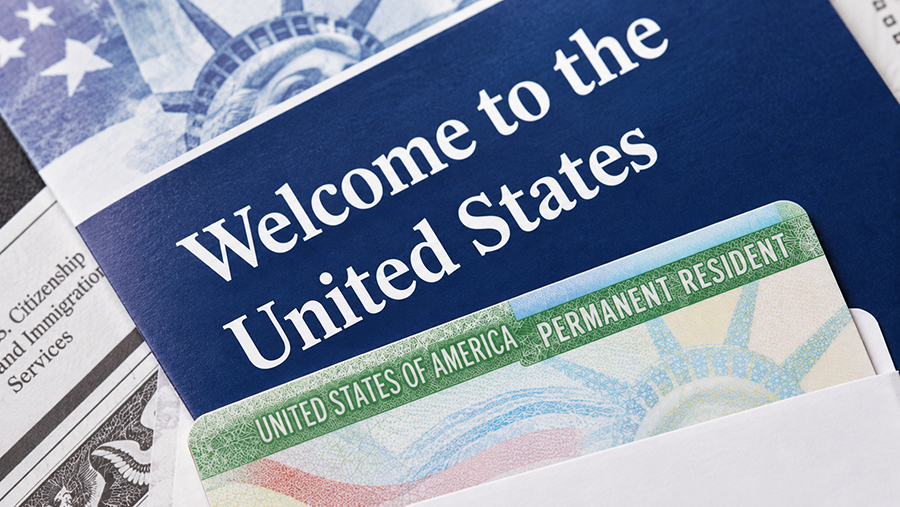
INA 319(b) is a law that allows foreign spouses of U.S. citizens to become naturalized citizens without meeting the standard residence and physical presence requirements that apply to other permanent residents. The USCIS Policy Manual defines this as expedited naturalization for applicants whose U.S. citizen spouse is regularly stationed abroad.
This pathway is designed specifically for couples where the U.S. citizen spouse is working or stationed overseas—meaning the applicant cannot satisfy the typical three-year continuous U.S. residence requirement because they are living abroad with their spouse. The law does not eliminate all naturalization requirements, but it removes the physical presence barriers that would otherwise disqualify someone living and working outside the United States.
Table of Contents
- Who Qualifies for INA 319(b)
- What Requirements Are Waived
- What Requirements Still Apply
- How to File and Where to Send Your Application
- Physical Presence and Interview Requirements
- When Your Spouse's Overseas Assignment Ends
- Frequently Asked Questions
Who Qualifies for INA 319(b)
To qualify, you must be a lawful permanent resident married to a U.S. citizen. Your spouse must be "regularly stationed abroad," defined as being assigned outside the United States for a period of not less than one year. The assignment does not have to be permanent, but it must be structured as a specific assignment or employment position lasting at least 12 months.
Your U.S. citizen spouse must be employed by the U.S. government, a recognized U.S. research institution, a U.S. corporation engaged in developing foreign trade, or a bona fide U.S. organization performing ministerial or missionary activities. This means the employment itself must connect to one of these four recognized categories; employment by a foreign company or foreign government does not qualify, even if it involves U.S. citizens.
What Requirements Are Waived
INA 319(b) completely waives the physical residence and continuous residence requirements. You do not need to be physically present in the United States for half of the qualifying period, and you do not need to reside in the state where you file your application for at least three months. This is the core relief that makes the pathway possible for families living overseas.
You also do not need to satisfy the three-year continuous residence requirement itself. While standard marriage-based naturalization requires three years as a permanent resident with physical presence for at least half that time, INA 319(b) removes both the residence period and the physical presence calculation. This allows your naturalization application to move forward based solely on your spouse's assignment abroad, not on how much time you have personally spent in the United States.
What Requirements Still Apply
The good moral character requirement for at least three years is not waived under INA 319(b). You must still demonstrate good moral character during the three-year period before filing, meaning no serious criminal convictions, fraud, or moral conduct issues during that time.
This requirement applies equally to all naturalization applicants regardless of the pathway they use. You must also demonstrate knowledge of U.S. history and government and pass an English language test covering speaking, reading, and writing. These are standard civics and language requirements that apply to all naturalization applicants. Additionally, you must declare in good faith an intention to reside permanently in the United States when your spouse's employment abroad terminates. This means you must express a commitment to establishing permanent U.S. residence once the overseas assignment ends.
How to File and Where to Send Your Application
Form N-400 applications under INA 319(b) file to the USCIS Phoenix Lockbox facility regardless of your location, except military spouses who file with the USCIS Nebraska Service Center. You will mark your application as filed under INA 319(b) when submitting to ensure it is processed under the expedited rules. Include documentation of your spouse's assignment abroad, such as employment letters, assignment orders, or company documentation showing the assignment period.
You will need to submit evidence of your good moral character (police clearances, employment records, references), proof of marriage, proof that your spouse is a U.S. citizen, and documentation of your lawful permanent resident status. Keep your proof of the one-year overseas assignment requirement together with other employment evidence, as this is central to the entire application.
Physical Presence and Interview Requirements
Although INA 319(b) waives continuous residence in the United States, you are not exempt from appearing for your naturalization interview and oath ceremony. You may complete fingerprinting either in the United States or abroad and may be interviewed at any domestic USCIS field office. This means you can arrange fingerprinting at a U.S. embassy or consulate while overseas, and you can choose any U.S. USCIS office for your interview—not necessarily the one in your state.
However, you must be physically present in the United States for the naturalization interview itself and for the oath ceremony. If you are living abroad, you will need to plan a trip to the United States to complete these final steps. Contact USCIS to schedule your interview once your application is accepted and processed.
When Your Spouse's Overseas Assignment Ends
Your INA 319(b) eligibility depends on your spouse's continuing assignment abroad during your naturalization process. If your spouse's assignment ends or changes before you are naturalized, you may still complete your application if you have met the good moral character requirement and file promptly. However, if the assignment terminates before you file, you lose the ability to use this pathway and would need to qualify under the standard three-year marriage-based naturalization rules instead, which would require meeting physical presence requirements.
Once you are naturalized, your status as a U.S. citizen does not depend on where your spouse works. You can live overseas, return to the United States, or live anywhere you choose—your citizenship is permanent regardless of your spouse's future employment.
Frequently Asked Questions
Do I need to be a green card holder to qualify for INA 319(b)?
Yes, you must be a lawful permanent resident (green card holder) married to a U.S. citizen. INA 319(b) is not available to other visa statuses or to those without permanent resident status.
What if my spouse is stationed abroad but works for a foreign company?
You do not qualify. Your spouse's employer must be the U.S. government, a U.S. research institution, a U.S. corporation engaged in foreign trade, or a bona fide U.S. organization performing ministerial or missionary activities.
Can I complete my entire naturalization process while living overseas?
No. While you can do fingerprinting abroad and have your interview at any domestic USCIS office, you must be physically present in the United States for your naturalization interview and oath ceremony.
How long does my spouse's overseas assignment have to be?
At least one year. The assignment must be structured and documented—temporary travel for work does not meet the requirement.