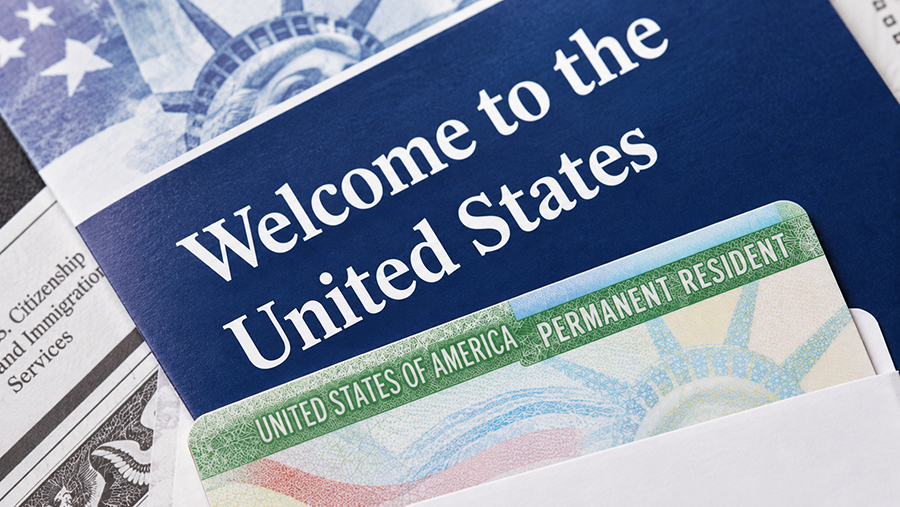
To sponsor a brother or sister for a U.S. green card, you must be a U.S. citizen age 21 or older and file Form I-130 (Petition for Alien Relative) with USCIS to establish your qualifying family relationship.
Your sibling will enter the employment-based immigration queue under the fourth preference (F4) family category, a visa class subject to severe annual caps that creates waiting periods ranging from 16 to 25 years depending on country of origin. The sponsorship process is legal and straightforward in its mechanics, but the timeline is the central constraint: you file the petition now, but your sibling may not receive a visa number to actually immigrate for one or more decades. The process requires documentation of your citizenship, proof of the sibling relationship, a signed Affidavit of Support showing you can financially sustain them, and a willingness to commit to that support obligation for years after they arrive.
Table of Contents
- Who Can Sponsor a Brother or Sister
- The F4 Category and Decades-Long Wait Times
- Proving the Sibling Relationship and Your Citizenship
- The Affidavit of Support and Income Requirement
- The Filing Process and Priority Date
- Including a Spouse and Children
- Frequently Asked Questions
Who Can Sponsor a Brother or Sister
Only U.S. citizens age 21 and older can sponsor a brother or sister for a green card; lawful permanent residents cannot petition for siblings. If you are a permanent resident (green card holder), you do not qualify as a petitioner, and no sponsorship pathway exists for you to bring a sibling to the U.S. This restriction applies even if the sibling would qualify in every other way. Your citizenship must be documented—a valid U.S. passport, naturalization certificate, or certificate of citizenship all satisfy this requirement.
The sibling you wish to sponsor must be your full sibling (sharing at least one common parent with you) or half-sibling, and they must be single or, if married, have no U.S. citizenship or permanent residency status. A sibling who is already a U.S. citizen or green card holder cannot be sponsored because they are no longer subject to immigration limits.
The F4 Category and Decades-Long Wait Times
Your sibling's sponsorship falls under the fourth preference (F4) family category, which is subject to annual numerical limits set by Congress. These limits are severe: in a given fiscal year, only a fixed number of F4 visas become available, and demand far exceeds supply. The practical result is that the visa availability does not advance to newer priority dates—the date when uscis formally receives your I-130—for many years.
Current wait times are measured in decades. As of October 2026, F4 categories face wait times ranging from 16 to 25+ years depending on country of origin: siblings from Mexico face a 25-year wait (priority dates from April 2001), the Philippines 22 years (January 2008), India 17 years (October 2006), and most other countries approximately 16 years (April 2008). These backlogs reflect years of demand accumulation and are the central reason sibling sponsorship is a long-term commitment rather than a near-term immigration path.
Proving the Sibling Relationship and Your Citizenship
Your petition must establish the qualifying family relationship beyond dispute. You must provide your sibling's birth certificate showing at least one common parent and documentation of your own U.S. citizenship such as a valid passport, naturalization certificate, or certificate of citizenship. Birth certificates must be original or certified copies; USCIS does not accept photocopies or secondary evidence unless the original is unavailable.
If the birth certificates lack sufficient detail or were issued decades ago in a country with poor recordkeeping, you may need to obtain affidavits from family members attesting to the shared parentage, or present evidence such as adoption decrees, divorce decrees naming both of you, or other official documents that establish the relationship. USCIS adjudicators review the evidence carefully because fraudulent sibling claims have occurred in the past. The clearer your documentation, the faster the petition process moves.
The Affidavit of Support and Income Requirement
You must complete Form I-864 (Affidavit of Support), agreeing to financially support your sibling and demonstrating household income at least 125% of the federal poverty guidelines, or secure a joint sponsor meeting the requirement. This is a binding legal obligation, not a formality: you are pledging to reimburse the U.S. government for any means-tested benefits your sibling receives (such as Medicaid, food assistance, or housing subsidies) for years after they arrive, and potentially until they become a U.S. citizen or have worked 40 calendar quarters in the U.S. Your household income is calculated by combining your own income with that of any household members or, if necessary, a joint sponsor (a relative or friend who also meets the income threshold and signs a separate I-864). Self-employment income, rental income, and Social Security are all countable.
If your income is borderline, adding a joint sponsor is a practical solution. Your income requirement does not change if your sibling has a spouse and children who will also immigrate under the same petition.
The Filing Process and Priority Date
The sponsorship process requires filing Form I-130 (Petition for Alien Relative), which establishes the qualifying family relationship and initiates the immigrant visa petition. You file the I-130 along with supporting documents, birth certificates, copies of your citizenship proof, and the completed I-864 Affidavit of Support. USCIS will review the petition, verify the family relationship, and if approved, assign your sibling a priority date—the date USCIS received the completed I-130.
The priority date is critical because the visa becomes available based on the priority date, and the beneficiary can apply for adjustment of status if in the U.S. or pursue consular processing abroad once a visa number becomes current. Your sibling will need to monitor the State Department's monthly Visa Bulletin to learn when the F4 category has advanced to their priority date. Once that date is current, they can proceed to the next stage: if already in the U.S., they file for adjustment of status; if abroad, they apply through the consular processing route at a U.S. embassy or consulate.
Including a Spouse and Children
A sibling's spouse and unmarried children under 21 can be included on the same I-130 petition and will follow the same priority date and visa availability as the principal beneficiary. You do not file separate petitions for the spouse and children; instead, you list them all on a single I-130, and when the priority date becomes current, all three (or more, if there are multiple children) can apply for adjustment or consular processing together. There are no additional visa numbers consumed by including them—they move as a family unit under one priority date.
This is significantly more cost-effective than waiting for the I-130 approval, your sibling obtaining a green card, then your sibling eventually becoming a citizen and sponsoring their own spouse and children many years later. If your sibling is currently single but married or has children by the time the visa becomes available, those dependents cannot be added retroactively; only dependents listed at the time of filing can immigrate under that priority date.
Frequently Asked Questions
Can I sponsor my sibling if I am a permanent resident (green card holder)?
No. Only U.S. citizens age 21 or older can sponsor a brother or sister. Permanent residents cannot petition for siblings under current immigration law.
What if my sibling is already married—can they still be sponsored?
Yes. Your married sibling and their spouse can both be included on the same I-130 petition and will share the same priority date. Any unmarried children under 21 can also be listed. If your sibling's spouse is a citizen of another country, they do not need to be a permanent resident or citizen to immigrate—they will follow your sibling's priority date.
If I file the I-130 now, when might my sibling actually receive a green card?
The wait time depends on country of origin. From Mexico, expect approximately 25 years; from most other countries, 16 years or more. The priority date is the date USCIS receives your petition, and your sibling can immigrate only when that date becomes current in the State Department's monthly Visa Bulletin.
What happens if I cannot afford to sponsor my sibling—can someone else sign the Affidavit of Support instead?
Yes. A joint sponsor (a relative or friend) can sign a separate Affidavit of Support if your income is insufficient. The joint sponsor must meet the same income requirement (125% of federal poverty guidelines) and is equally liable for any benefits your sibling receives.