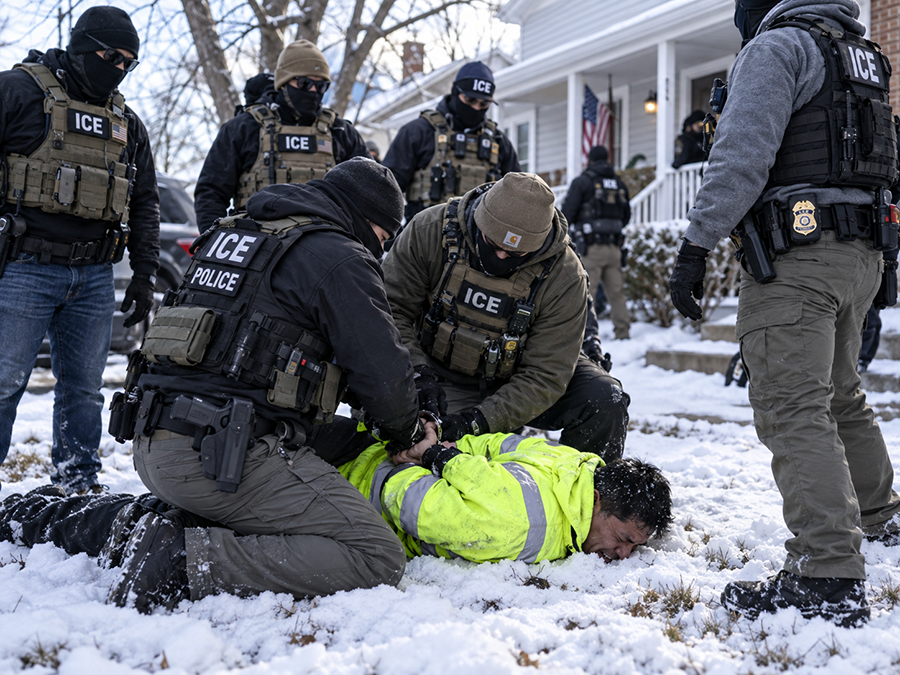
Witness testimony and medical evidence show that a Cuban immigrant in U.S. Immigration and Customs Enforcement custody died after guards applied a chokehold—with the detainee repeatedly saying "I can't breathe"—according to accounts documented by the Associated Press.
Geraldo Lunas Campos died at an ICE detention facility near El Paso, Texas, in early January 2026, and the death was subsequently ruled a homicide. The case raises questions about detainee safety, ICE accountability, and what happens when an initial agency account conflicts with autopsy findings and witness testimony. Immigration readers should understand what the evidence shows, how the agency responded, and what investigation followed.
Table of Contents
- What Witnesses Saw During the Restraint
- The Medical Examiner's Homicide Ruling
- ICE's Contradicting Account Contradicted by Evidence
- Criminal Investigation and Uncertain Prosecution
- What This Means for Detainee Protections
- Frequently Asked Questions
What Witnesses Saw During the Restraint
According to witness testimony obtained by the AP, at least five guards held Lunas Campos down while handcuffed, and one guard placed an arm around his neck and squeezed until he lost consciousness within approximately five minutes. The witness heard the detainee repeatedly saying "I can't breathe" in Spanish during the restraint.
After Lunas Campos stopped responding, guards removed his handcuffs. This account is significant because detainees cannot easily report what happens inside a facility, and firsthand witness testimony from another person in custody is often the only documentation of the restraint itself. The detail that the victim was already handcuffed when the chokehold was applied is a material fact about whether the use of force was necessary.
The Medical Examiner's Homicide Ruling
The El Paso County Medical Examiner ruled the death a homicide caused by asphyxia due to compression of the neck and torso on January 21, 2026. The autopsy found physical evidence consistent with choking: petechiae—small red marks indicating burst blood vessels—in the eyelids and neck, abrasions on the chest and knees, and neck hemorrhages.
A medical examiner's ruling of "homicide" does not mean someone will be prosecuted for murder; it is a medical classification stating that the death resulted from the actions of another person. In this case, the term means the chokehold caused the death, not that ICE intentionally killed him—a distinction that shapes both the legal questions and what comes next.
ICE's Contradicting Account Contradicted by Evidence
The department of Homeland Security initially told the public a different story. DHS claimed Lunas Campos "attempted to take his own life" and that "security staff immediately intervened to save his life," a characterization that is directly contradicted by witness testimony and the medical examiner's homicide finding.
An intentional chokehold applied by guards is not an intervention to prevent suicide; it is a restraint technique that killed him. This contradiction matters because detainees and their families must rely on agency transparency to know what actually happened. When an official account is later proven wrong by independent medical evidence, it raises questions about whether the initial account was incomplete, inaccurate, or deliberately misleading.
Criminal Investigation and Uncertain Prosecution
The FBI opened an investigation into Lunas Campos' death following the medical examiner's homicide ruling, more than three months after his death. At the time of reporting, it was unclear whether prosecutors would pursue criminal charges against the guards involved. The investigation is ongoing, and the case sits in federal jurisdiction because the death occurred in custody under a federal agency.
Federal cases involving law enforcement use of force are difficult to prosecute and rarely result in convictions. The burden of proving that the guards acted willfully and with criminal intent—rather than in good faith but with excessive force—is high. The status of any potential charges remains unknown.
What This Means for Detainee Protections
Cases like this highlight why detainee treatment in ICE custody matters to immigration readers: many people in the immigration system spend time in detention while their cases are pending, and they have limited ability to report what happens inside. Witness accounts, medical evidence, and transparent investigations are the primary safeguards when agency accounts conflict with documented facts.
The case does not directly change immigration policy or eligibility rules, but it is part of a pattern of accountability questions around detention practices. Immigration attorneys, advocacy groups, and detainee families track these cases because they inform broader discussions about detention conditions and agency responsibility.
Frequently Asked Questions
Could the guards be prosecuted criminally?
The FBI investigation is ongoing. Federal prosecutors could pursue criminal charges, but these cases rarely result in convictions. The legal burden requires proving the guards acted willfully and intentionally, not merely with excessive force.
Does this change how ICE operates?
Not automatically. The case may inform policy discussions or settlements with the deceased's family, but the investigation outcome will determine whether any formal accountability follows.
What happened to the witness who reported this?
The available reporting does not specify the witness's identity or current status, only that they were present and gave an account to the AP.