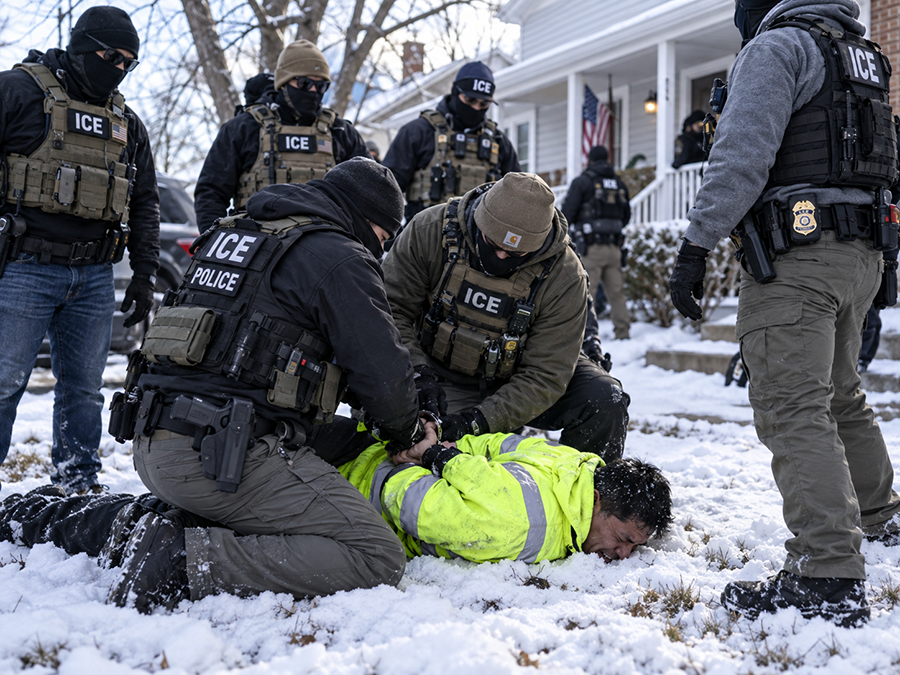
U.S. military veterans who are citizens have been arrested by Immigration and Customs Enforcement (ICE) during immigration raids, with agents detaining them despite their citizenship status and military service. George Retes, an Army veteran and U.S. citizen, was held by ICE for three days in Southern California in 2025 after agents broke his car window, pepper-sprayed him at a roadblock, and placed him in isolation without charges or legal counsel, according to the Institute for Justice.
These cases expose a pattern where citizens with no immigration violation are detained during enforcement operations, suggesting systemic gaps in how ICE verifies immigration status before arresting individuals. Multiple documented cases show this is not an isolated incident. Veterans have been mistaken for immigrants across different states, detained without immediate confirmation of citizenship, and subjected to enforcement procedures designed for people facing deportation. The cases raise questions about why ICE detention of U.S. citizens occurs despite federal policy explicitly prohibiting it.
Table of Contents
- Verified Cases of Citizens Detained by ICE
- How These Detentions Occur
- Systemic Gaps in Oversight and Accountability
- Legal Rights for Wrongfully Detained Citizens
- What to Do If You Are Detained by ICE
Verified Cases of Citizens Detained by ICE
Jilmar Ramos-Gomez, a U.S. Marine Corps veteran, was wrongly detained by ICE in Michigan after an off-duty police captain reported him to ICE based on his Latino name and appearance, despite no evidence of immigration status violation, according to the ACLU of Michigan. His case, reported in 2018, illustrates how enforcement can rest on assumptions about appearance rather than evidence.
In January 2025, a U.S. Army veteran in Newark, New Jersey was detained during an ICE raid on a seafood business, with the city's mayor reporting that agents questioned his military identification despite him presenting valid veterans credentials. These three cases span from 2018 through 2025, suggesting the problem recurs repeatedly rather than being corrected after individual incidents.
How These Detentions Occur
The cases show ICE agents do not always verify citizenship status before detaining individuals. In Retes's case, agents did not accept his documentation or offer him the opportunity to contact legal representation during three days in custody. In the Ramos-Gomez case, an officer's personal identification of him as someone to report to ICE, based on race and appearance alone, initiated the detention without any independent verification of immigration status.
The pattern suggests that ICE enforcement operations rely partly on initial assessments that can be incorrect, with verification happening only after arrest rather than before. This is particularly significant for citizens who present identification—the Newark veteran's military credentials did not prevent his detention.
Systemic Gaps in Oversight and Accountability
The Government Accountability Office (GAO) found ICE does not track the extent to which its officers take enforcement actions against U.S. citizens, indicating a systemic lack of oversight into wrongful detention cases. Without tracking, there is no measure of how frequently citizens are detained, whether they are concentrated in certain regions or enforcement operations, or whether corrective patterns exist.
Despite this, DHS policy explicitly states "as a matter of law, ICE cannot assert its civil immigration enforcement authority to arrest and/or detain a U.S. citizen". The gap between policy and practice—with cases continuing even with this prohibition in place—suggests that individual officers' decisions are not consistently constrained by the rule.
Legal Rights for Wrongfully Detained Citizens
Citizens wrongfully detained by ICE have potential legal remedies. U.S. citizens wrongfully detained by ICE may pursue claims under the Fourth Amendment, Fifth Amendment, or Federal Tort Claims Act, but federal law makes it difficult to hold individual officers civilly liable for constitutional violations. Retes has pursued this path, filing a federal civil rights lawsuit, and other cases highlight how difficult it is for citizens to hold federal immigration officers liable for wrongful detention.
The barriers include sovereign immunity protections for federal agents and the burden of proving that officers acted recklessly or in bad faith rather than making a mistake. This means that a wrongfully detained citizen may have a legal claim, but proving it and recovering damages or preventing future detentions requires substantial litigation.
What to Do If You Are Detained by ICE
If you are approached by ICE agents, you have rights even if you are a citizen: Your citizenship status should prevent detention for immigration purposes, but as these cases show, it may not stop it immediately. Having documentation, asserting your rights clearly, and seeking legal help quickly are your best protections.
- **Do not sign anything** without understanding it fully and consulting a lawyer.
- **State clearly "I am a U.S. citizen"** and provide identification if you have it.
- **Ask for a lawyer immediately** and repeat this request if agents continue questioning you.
- **Do not consent to searches** of your vehicle, home, or belongings without a warrant signed by a judge.
- **Record the names and badge numbers** of any agents who detain you, and ask witnesses for their contact information.